
Long Way to a Neighbour
Akhtar Malik
Head of Programs
1. INTRODUCTION
When I think about India’s Act East Policy, I start with a sack of pulses. Imagine a trader in Manipur buying it from a supplier in Myanmar. The supplier can ship it to Kolkata or Vizag, where it clears customs and begins the long journey back east by truck. If the land crossing at Moreh is closed, the trader cannot take delivery through nearby Tamu. The two countries can do more business even as two neighbours find it harder to trade.
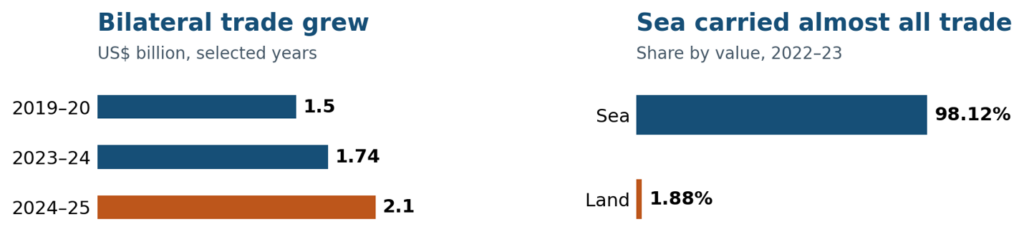
That is precisely what the national figures can conceal. India – Myanmar trade grew from about USD 1.5 billion in 2019 – 20 to USD 2.1 billion in 2024 – 25. In the latter year, India bought USD 1.53 billion worth of goods from Myanmar, including pulses, and exported USD 614 million. Yet in 2022 – 23, just 1.88 per cent of bilateral trade by value crossed the land border. In 2023 – 24, the combined value through Moreh – Tamu and Zokhawthar – Rih was USD 32.85 million.
For bulk cargo, shipping by sea often makes commercial sense. The real concern is the buyer close to the frontier who has no dependable local option. India shares 1,643 kilometres of border with Myanmar across four states. Only Moreh in Manipur and Zokhawthar in Mizoram have handled regular formal trade. The pandemic, Myanmar’s 2021 coup and unrest in Manipur disrupted those routes. Elsewhere, a vehicle could reach the border and still have nowhere to declare its load.
A closed customs gate tells us little about demand. One estimate puts informal trade at Moreh at INR 10 – 15 crore a day, covering goods such as textiles, medicines, and cigarettes. Narcotics trafficking is a separate enforcement concern. One will have to be cautious about treating the informal estimate as potential customs revenue or assuming all those goods qualify for legal trade.
Act East policy, therefore, needs to be judged by the journey a trader can actually complete. In Manipur, that means getting an existing freight crossing working again. In Mizoram it means deciding which of two routes a consignment would use. Farther north, the first decision is whether a road or a market can support regular trade at all
2. TWO CROSSINGS, TWO KINDS OF TRADE
Moreh shows how quickly a familiar trading route can unravel. Trade with Tamu fell from INR 356 crore in 2019 – 20 to INR 3.11 crore the next year. By 2024, nearly six in ten shops in Moreh had closed. A temporary arrangement allowed people to carry selected goods, including vegetables and dry fish, across by hand. For a household, that was a way to keep earning. For a wholesaler trying to dispatch a truck, it left the delivery question open.
Moreh already has warehouses, inspection space, and a food-testing laboratory. The lab lacks equipment for the required tests, and internet speeds at some border facilities have been as low as 8 Mbps. A trader arranging a load of fresh produce would want to know before hiring the truck whether customs could accept the filing, the lab could test the goods, and the buyer could collect them at Tamu. A delay at any one of those points can wipe out the saving from a shorter journey.
Across the state line in Mizoram, Zokhawthar has a customs station, warehouse and weighbridge. Rih, on the Myanmar side, is a familiar market. Yet only a handful of export consignments went through the formal channel over a decade. Imports included betel nut, leather goods and black pepper. Before adding another facility, it is critical to ask traders in these two markets which goods they could deliver regularly through the crossing.
2.1 WHERE KALADAN FITS
Farther south, Zorinpui serves a different purpose. It is the Mizoram endpoint of the planned Kaladan route. Follow it from Kolkata, and a consignment changes mode twice. It travels by sea to Sittwe in Myanmar, up the Kaladan River to Paletwa, then by road to Zorinpui. Each transfer needs an operator who can receive the cargo and arrange the next leg.
At Zorinpui, 11.38 hectares have been earmarked for a customs station. Nearby farms grow bananas, pineapples, mangoes and oranges, some of which spoil for lack of storage and buyers. For a grower, the immediate question is who will collect the fruit and how soon it can reach a buyer. That answer should guide investment in collection points and storage while Mizoram develops the corridor and serves the existing market at Rih.

Figure 1: Kaladan Multimodal Transit Transport Project
3. HOW FAR CAN A CONSIGNMENT TRAVEL?
In Nagaland, the case for a crossing depends on how far a laden vehicle can go beyond it. Of the two candidates, Longwa and Avangkhu, let us start at Avangkhu. The state has set aside 50 acres near the border, and traders already exchange grain, salt, and cooking oil but not through a dedicated border haat. What gives Avangkhu wider potential is the road towards Lay Shi and, beyond it, Hta Man Thi on the Chindwin River. The Chindwin joins the Irrawaddy, opening a possible route to buyers deeper inside Myanmar.
Now consider what that journey would ask of a transporter. Avangkhu is about 280 kilometres from Kohima and 350 from Dimapur, the nearest major transport hub. On the Myanmar side, roughly 43 kilometres of single-lane, unpaved road lead to Lay Shi. Hta Man Thi lies about 100 kilometres from the border. A truck that reaches Avangkhu has completed only part of the difficult stretch.
Before committing to a terminal, one would trace a load all the way from Dimapur to the river. Can the vehicle cross the Tizu bridge, continue beyond Lay Shi and unload at Hta Man Thi? The answer determines the size of vehicle an operator can send, how many transfers the goods need and what the trader will pay. Another warehouse cannot settle any of those questions.
At Nampong in Arunachal Pradesh, a shorter journey points to a different starting point. The last 10-12 kilometres to Pangsau Pass follow a paved stretch of the historic Stilwell Road. Tinsukia is about 110 kilometres away. Before the pandemic, residents met at supervised border markets. Buyers came from Myanmar for rice, pulses, cooking oil and medicines. Disused customs buildings and the remains of market stalls mark where that exchange took place. Although the border haat has been restarted three times a month, recording what changes hands over several months would tell officials which goods move regularly and how much space traders need. That is a firmer basis for deciding whether to station staff permanently or build a freight facility.
Figure 2: Avangkhu and the markets along the Chindwin.
3. WHAT TO DO FIRST?
For a trader in Champhai buying pulses from a supplier across the Tiau, the value of Act East comes down to three questions. Can a carrier quote a price, can the consignment clear Customs, and can the trader give the buyer a delivery date? These questions should be used to set priorities at each crossing. The answer will differ between a village haat serving nearby growers and a transit route carrying freight across states.
- Make market days dependable at Pangsau Pass. Authorities and trader bodies on both sides should agree on a calendar, publish clear rules for vendor participation and give traders advance notice of suspensions. Growers could then time their harvests and share transport, while guides and homestays in Nampong could plan visits around market days and the wartime sites near Jairampur.
- Make deliveries to Avangkhu viable from both sides. Improve the reliability of the approach road from Kohima and agree with Myanmar counterparts on a point where buyers or carriers can receive consignments. A transporter quoting for the journey from Dimapur or Kohima needs to know where the handover will take place, if the commodities will be allowed and how much time to allow for the return trip.
- Use periodic markets to guide investment at Avangkhu and Longwa. Record which goods attract repeat buyers, where those buyers come from, and whether traders can fill a shared vehicle. At Longwa, include the approaches through Assam and sales of local crafts to visitors. These records can help Nagaland decide where a basic loading area will suffice and where volumes justify storage or a permanent Customs presence.
- Plan the reopening of Moreh and Tamu together. Provide for the safe return of displaced traders and transport operators, check that vehicles can use the onward road, and confirm that clearance facilities at Tamu are ready. Traders on both sides need confidence that they can complete a delivery before they commit goods or vehicles.
- Plan Mizoram’s two gateways around the cargo each will serve. The Centre and the state should map the origins and destinations of consignments likely to use Zokhawthar, which serves the Champhai–Rhi market, and Zorinpui, the entry point for Kaladan cargo arriving via Sittwe and Paletwa. Use that evidence to allocate Customs staff, testing facilities and storage while protecting access for traders already doing business across the Tiau.
- Test the Chindwin option with one commodity over one complete journey. India and Myanmar should compare a domestic road quote from Avangkhu to Moreh with the full cost of transit through Myanmar, including road transfers, loading, waiting for a sailing, Customs procedures and the return leg. If the river is navigable in the required season and the costs are favourable, the two governments could agree on exit and re-entry procedures and undertake a trial shipment when security conditions permit.
- Give lawful trade an accessible route and focus enforcement on illicit flows. At designated crossings, growers should be able to sell permitted produce, and commercial importers should be able to document origin, meet product requirements and pay duty. Staffed crossings would give local firms the paperwork to hire carriers and invoice buyers, while giving authorities a record of legitimate flows to support intelligence-led action against smuggling and narcotics trafficking.
I come back to the trader buying pulses. Before placing an order, that trader needs to know where the sack can cross, when it will arrive, and what the journey will cost. Giving buyers and sellers on this frontier a dependable answer would make Act East.
